
How to Choose a Dewatering Pump: A Site Manager's Guide
Five numbers decide which pump you need. Get them right and the pump is boring — it just runs. Get them wrong and you will be buying a second one by the middle of the monsoon.
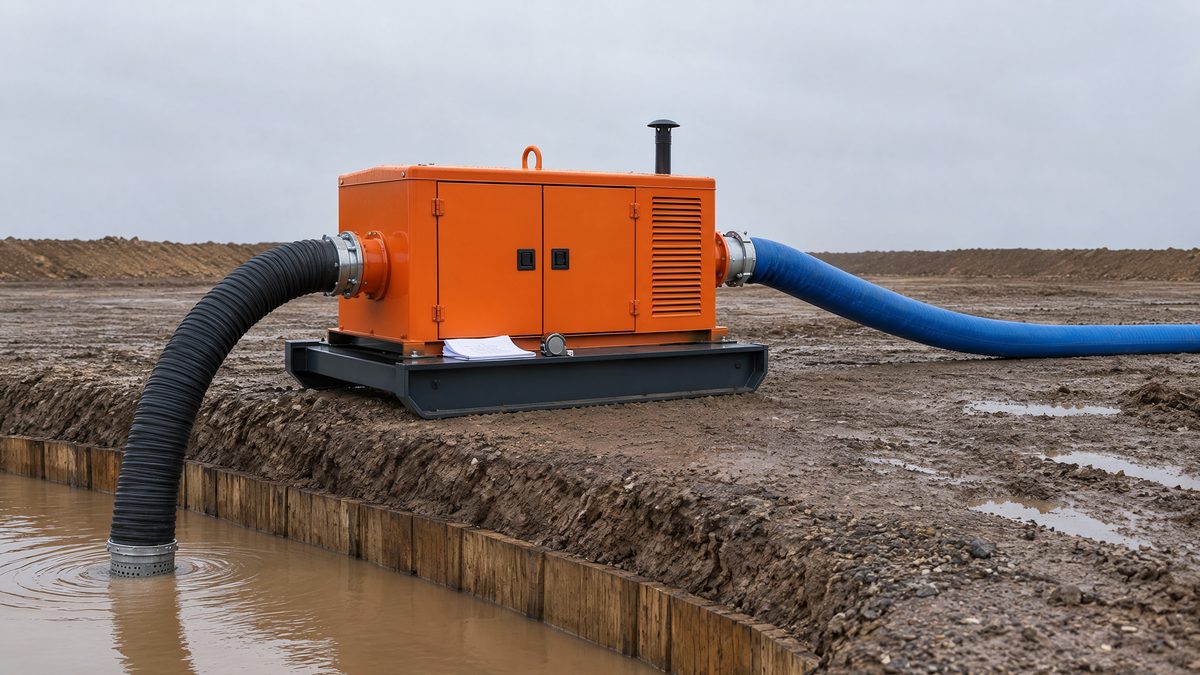
Almost every dewatering pump enquiry we get starts the same way: "I need a 4-inch pump." Sometimes that is right. Often it is not, because the discharge size is the one specification that tells you least about whether a pump will do your job.
Choosing a dewatering pump properly comes down to five numbers. None of them requires an engineering background — you can work all five out standing at the edge of the pit with a tape measure and a bucket. Here is how.
1. How much water: flow rate
Flow is how much water the pump moves per hour, usually written in litres per minute (LPM) or cubic metres per hour (m³/h). What you need is not "as much as possible" — it is enough to remove the water coming in, plus enough spare to draw the level down in a reasonable time.
The bucket method. If water is already collecting, let the pit fill for a measured period with no pumping. Measure the depth it rises and multiply by the pit area:
Inflow (m³/h) = pit length (m) × pit width (m) × rise in depth (m) ÷ hours measured
Example: a 10 m × 8 m pit rises 0.15 m in 2 hours → 10 × 8 × 0.15 ÷ 2 = 6 m³/h of inflow.
Then size the pump at roughly two to three times the measured inflow. That margin does two things: it lets you draw the level down instead of just holding it, and it covers the day the rain doubles the inflow. In our example, a pump rated at 15–20 m³/h at your working head is comfortable — which is well inside a 3-inch pump.
If nothing has been excavated yet, ask the soil investigation report for the permeability, or ask a contractor who has worked on the adjacent plot. Local experience beats a formula on Indian sites.
2. How high and how far: total head
This is the number people get wrong, and it is the one that decides whether the pump works at all. Total head is not just how high you are lifting the water. It is three things added together.
- Static suction lift — the vertical distance from the water surface up to the pump. Keep this under about 6 m for a self-priming surface pump; beyond that, physics stops cooperating.
- Static discharge head — the vertical distance from the pump up to where the water comes out.
- Friction loss — the resistance of the hose or pipe run. This is the part people forget, and on a long run it can exceed the actual lift.
A field rule for friction loss: for a hose of the correct size running at sensible velocity, allow roughly 1 metre of extra head for every 10 metres of hose. Add about 1 metre for each bend, valve or coupling.
Example: lifting water 8 m out of a pit, then running 60 m of hose across the site with four bends → 8 m lift + 6 m friction + 4 m fittings ≈ 18 m total head. Not 8.
Now read the pump's flow at that head, not its maximum flow. Every centrifugal pump moves less water as the head rises; a pump advertised at 1,600 LPM might deliver 900 LPM at 25 m. When we quote, we tell you the flow at your head — if a supplier only quotes you the maximum, ask again.
3. What is in the water: solids handling
Site water is never clean. The question is what size and how abrasive the solids are, because that decides both the pump type and how long its wear parts last.
- Clear seepage, fine silt only — a standard dewatering pump is fine.
- Muddy water, sand, small gravel — you need a sludge pump with a wide throat, an open or semi-open impeller and a replaceable wear plate.
- Heavy slurry, mine water, ash — you need abrasion-resistant materials as well: high-chrome wear parts or a full rubber lining, as on our 8-inch mine dewatering pump.
Two practical points. First, always fit a suction strainer and keep the intake off the bed of the sump — most "the pump has stopped" calls are a blocked or buried strainer, not a failed pump. Second, remember that solids reduce output: a pump handling heavy slurry will deliver noticeably less than its clean-water rating, which is why we build a margin into the sizing.
4. How long it runs: duty cycle
A pump that runs four hours a day for a fortnight and a pump that runs continuously for eight months are not the same purchase, even at the same flow and head.
- Intermittent duty (a few hours a day, weeks at a time) — a standard build is fine, and this is usually the clearest case for renting rather than buying.
- Continuous duty (24 hours, months at a time) — specify a heavier build: larger bearings, a mechanical seal instead of packing, and easily replaceable wear parts. Also budget for a standby unit, because a continuous-duty pump will eventually need to come off line.
A useful question to ask yourself: if this pump stops at 2 a.m., what does it cost me? If the answer is "a flooded excavation and a lost day", buy the standby. It is cheaper than the day.
5. What you can power it with
The best pump for your duty is useless if your site cannot run it. Check this before you order, not after it arrives.
- Three-phase 415 V available and stable — an electric motor is cheaper to buy, cheaper to run, quieter and needs less maintenance. Choose this whenever you can.
- Single phase only — this limits you to smaller pumps, realistically up to about 3 HP such as our GA-50.
- No reliable power, or the pump has to move around site — a diesel or petrol engine drive. More expensive to run and noisier, but it does not care about a tripped supply.
Also check the cable run. A long undersized cable causes a voltage drop that will burn out a motor just as effectively as a blocked impeller, and it is not the pump's fault.
Three expensive mistakes
Choosing the pump by pipe size
"I need a 4-inch" tells us the connection, not the duty. Two 4-inch pumps can differ by a factor of three in delivered flow at 25 m head. Give us flow and head; the connection size follows.
Ignoring friction in the hose run
The single most common cause of a pump that "does not perform". The pump is fine — it is being asked for 22 m of head when it was sized for 10 m. Either shorten the run, go up a hose size, or size the pump for the real head.
Buying clean-water hydraulics for dirty water
A clean-water pump on a muddy site will pump beautifully for about a week. Then the impeller edges round off, the clearances open up, output falls, and the pump is quietly finished. If the water has anything in it, buy for that from the start.
Quick selection table
| If your site is… | Typical flow needed | Typical head | Start with |
|---|---|---|---|
| Flooded basement or lift pit | Up to 400 LPM | Up to 20 m | GA-50 (2") |
| Trench or small excavation | 400–900 LPM | Up to 28 m | GA-80 (3") |
| Foundation pit / basement raft | 900–1,600 LPM | Up to 32 m | GA-100 (4") |
| Deep excavation in monsoon | 1,600–3,200 LPM | Up to 38 m | GA-150 (6") |
| Mine or quarry sump | 3,200–5,500 LPM | Up to 45 m | GA-200 (8") |
| Deep shaft or high-rise basement | Up to 1,200 LPM | Up to 90 m | GA-100HH |
The short version
Measure the inflow, add up the real total head including friction, be honest about what is in the water, decide whether the duty is occasional or constant, and check what you can power. Five numbers, half an hour of work, and you will not buy the wrong pump.
If you would rather just send us those five numbers, do that — sizing is free and we will tell you honestly if a smaller pump will do, or if renting one for the season makes more sense than buying.
Send us your site details and we will size the pump for you. Pit dimensions, how far the water has to go, what it looks like, and for how long. A reply within two working hours.
Related reading
Tell us about the water. We will tell you the pump.
Pit depth, discharge distance, how dirty the water is, and how long you need it for — that is all we need to quote. No obligation, and an honest answer if you need less pump than you think.