
Industries We Pump For
Construction, mining and industrial sites all end up with water where it should not be — but the water is different every time, and so is the right pump. Here is the problem we solve in each sector.
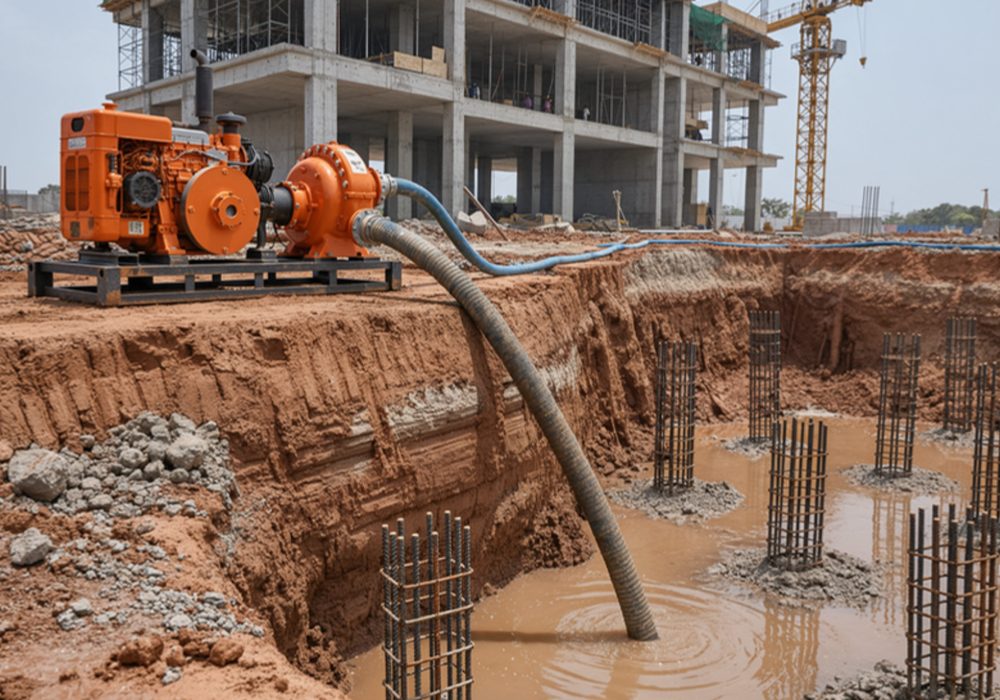
Construction site dewatering
The problem: the water table is above your foundation level, it rained last night, and forty people are standing at the edge of a pit they cannot work in.
Ground water does not care about your programme. On most Indian sites the first real dewatering crisis arrives with the excavation and never fully goes away until the basement is watertight. The cost is rarely the pump — it is the shift that did not happen, the concrete that could not be poured, the shuttering that had to come out again, and the labour standing idle at the top of the slope.
What we do about it:
- Size the pump against the actual inflow and the discharge run, not against the trench width
- Specify solids handling for excavation water — mud, sand and concrete washings, not clean water
- Recommend a standby unit for critical pours, so a single pump failure does not stop a raft
- Deliver and commission the same day across NCR when the water arrives faster than the plan did
Typical applications: deep basement excavation, raft and footing pits, pile caps, sewer and drainage trenches, tunnels and metro cut-and-cover, retaining wall drainage, monsoon flood clearance, tank and sump emptying.
Usual models: GA-80 (3") for trenches, GA-100 (4") for foundation pits, GA-150 (6") for deep excavation and monsoon work.
Mining dewatering pumps
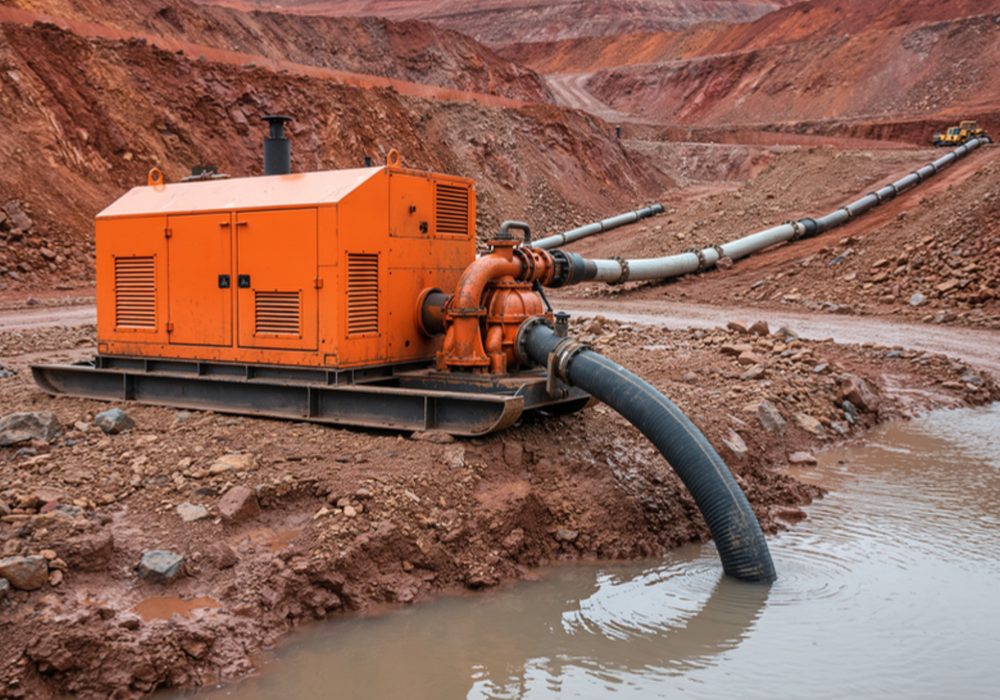
The problem: the water never stops coming, it is full of the material you are mining, and every pump you have tried has been eaten from the inside.
Mine water is a different animal from site water. It is abrasive, often acidic, and the duty is continuous rather than occasional — a pump that would last five years on a building site can be worn through in a single season in a pit sump. Add a deep lift to the discharge point and an undersized pump simply never gets the water out at all.
What we do about it:
- Build the wet end for abrasion: high-chrome impellers, heavy rubber lining, replaceable wear plates
- Design for rebuild, not replacement — every wear part comes off on site with ordinary tools
- Offer genuine high-head hydraulics for deep lifts instead of staging two pumps in series
- Hold your wear parts in stock so a change-out is a day's work, not a month's wait
Typical applications: open-cast pit sumps, underground level drainage, seepage and inflow control, tailings and slurry transfer, quarry dewatering, wash plant recirculation, monsoon pit clearance.
Usual models: GA-150 (6") and GA-200 (8") for sump duty, GA-100HH where the lift is the problem — plus rubber wear sleeves and liners from our own moulding shop.
Industrial & process pumping
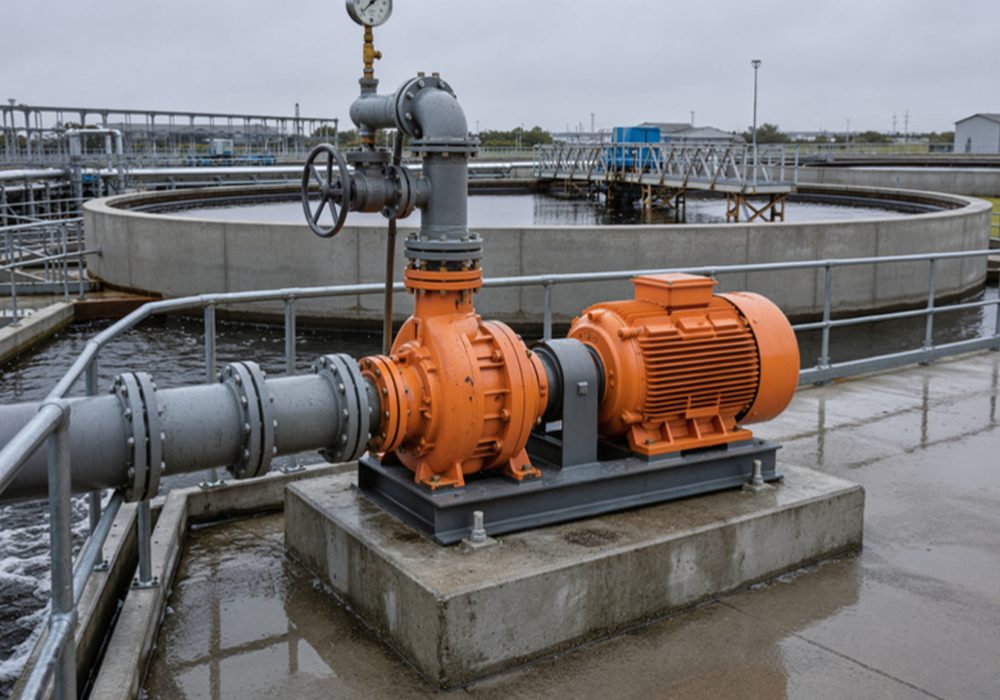
The problem: a sump that has to be emptied during a shutdown window measured in hours, with something in the water that will attack an ordinary pump.
Plant dewatering is less about volume and more about compatibility and timing. The water might be hot, chemically aggressive, full of fibre or ash, or all four. And it usually has to be moved inside a planned shutdown, where every hour the pump is not running is an hour of the shutdown gone.
What we do about it:
- Match materials of construction and elastomers to the actual medium — pH, temperature, solids
- Supply matched rubber sleeves, liners and expansion joints from the same works as the pump
- Provide standby units for shutdown windows so a failure does not extend the outage
- Support the maintenance team directly, without a distributor in between
Typical applications: ETP and STP sump transfer, cooling tower and cooling pit clearance, ash handling and ash pond water, tank and vessel cleaning, floor washings, boiler house drainage, monsoon flooding in plant basements and cable trenches. Where the liquor carries rags or fibre, these move to our non-clog GA-SW pumps.
Usual models: GA-100 (4") for routine sump duty, GA-150 (6") for shutdown clearance, with compound-matched rubber sleeves for the lines around them.
Quick reference
Find your situation, find your pump
| Your situation | Water type | Start with | Buy or rent? |
|---|---|---|---|
| Flooded basement or lift pit | Dirty water, light silt | GA-50 (2") | Rent — it is a one-off |
| Pipeline or drainage trench | Muddy, sandy | GA-80 (3") | Buy if you dig regularly |
| Foundation pit / raft pour | Muddy, continuous inflow | GA-100 (4") | Buy, plus a rented standby |
| Deep excavation in monsoon | Heavy silt, high volume | GA-150 (6") | Rent for the season |
| Open-cast mine sump | Abrasive slurry, continuous | GA-200 (8") | Buy — it will run all year |
| Deep shaft or high-rise basement | Seepage, long vertical lift | GA-100HH | Buy for permanent duty |
| Plant shutdown, sump emptying | Chemical / hot / fibrous | GA-100 or GA-150, material-matched | Rent for the window |
| Sewer bypass or STP tank emptying | Sewage with rags and solids | GA-SW-150 (6" non-clog) | Rent — usually short duration |
| Manhole or wet-well desludging | Sludge, grit and septage | GA-SW-100 (4" non-clog) | Buy if you desludge routinely |
Tell us about the water. We will tell you the pump.
Pit depth, discharge distance, how dirty the water is, and how long you need it for — that is all we need to quote. No obligation, and an honest answer if you need less pump than you think.