
Surface Dewatering Systems
Open sump and ditch dewatering — the fastest, cheapest way to keep an excavation dry when the ground is cohesive and the job is temporary. We supply and rent the pumps, size them against your actual inflow and head, and commission them on site.
Surface dewatering
The oldest method of keeping a site dry, and still the right one most of the time
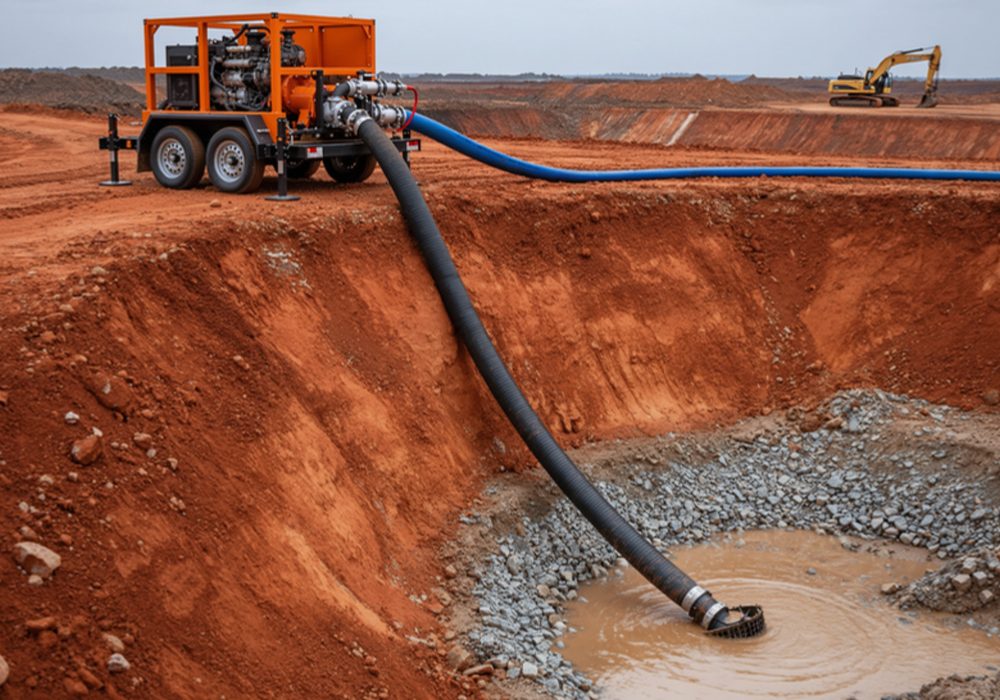
Surface dewatering — also called open sump or open pit dewatering — means letting water collect where you want it, then pumping it away. You cut perimeter ditches around the excavation, run them to a sump dug below the working level at the toe of the slope, and keep a pump on that sump.
It is unglamorous and it works. For most building sites, road jobs and shallow excavations in cohesive or low-permeability soil, it costs a fraction of a wellpoint installation and needs no specialist crew to run. One person who knows how to prime a pump and clean a strainer can hold a site dry through a monsoon.
What makes the difference between a system that works and one that floods the site anyway is not the method. It is whether the pump was sized against the real inflow and the real total head — and whether it can survive the silt that comes with the water.
- Lowers water to below working level
- No specialist installation
- Works in cohesive, low-permeability soils
- Fastest system to mobilise
Choosing the method
When surface dewatering is the right answer — and when it is not
We sell pumps, so you would expect us to say this method suits everything. It does not, and sending you a pump for a job it cannot do helps nobody. Here is the honest version.
Use surface dewatering when…
- The excavation is shallow to moderate — broadly down to 5–6 m below the water table
- The soil is cohesive or low permeability — clay, silty clay, weathered rock, mixed fill
- You mainly need to clear rainwater, seepage and monsoon inflow rather than draw down a whole aquifer
- The side slopes are stable and you can cut ditches and a sump without undermining them
- You need something working today, not after a week of installation
- The job is temporary — a phase of work, a season, a shutdown
Think again when…
- The soil is clean sand or gravel with high permeability — open pumping can draw fines out with the water
- You are seeing boiling, piping or slope instability at the base of the excavation
- You need a deep, uniform drawdown across a wide area before excavating at all
- The excavation must stay completely dry during the cut, not dried out afterwards
Those four situations usually call for a wellpoint or deep-well system, which is a different technique installed by specialist contractors. We do not install those — but we will tell you plainly when we think you need one rather than sell you a pump that will not solve it.
The arrangement
How a surface dewatering system is put together
Six parts. Get any one of them wrong and the pump gets blamed for it.
1 · Stable side slopes
Before anything is pumped, the slope has to stand up. Battered back, benched, or supported. Pumping water out of an unstable slope accelerates the failure rather than preventing it.
2 · Perimeter ditches
Shallow channels at the toe of the slope, graded to fall towards the sump. They intercept seepage before it crosses the working area, which is what keeps the floor trafficable.
3 · A sump, below working level
Dug 1–1.5 m below the floor so water collects there and not where people are working. Line it with stone or a perforated drum to stop the sides collapsing into your strainer.
4 · Strainer, held off the bed
Suspend the strainer on a brick or a float so it draws from clear water rather than the silt bed. This single detail prevents most of the "the pump has stopped" calls we take.
5 · A self-priming pump on the bank
Surface-mounted, so it is easy to reach, service and move. Self-priming means it pulls its own water up without anyone having to fill the casing by hand every morning.
6 · Discharge well clear of the excavation
Far enough away that the water does not find its way back. Run it through a silt trap or settling tank before it enters a storm drain — most municipal consents require it.
Equipment
The pumps we supply for surface dewatering
All self-priming, all built to pass the silt and grit that come with excavation water, and all with the figures published here rather than hidden in a PDF you have to ask for.
| Model | Discharge | Max flow | Max head | Power | Solids | Typical use |
|---|---|---|---|---|---|---|
| GA-50 | 50 mm (2") | 400 LPM | 20 m | 3 HP | 8 mm | Lift pits, small trenches, tank emptying |
| GA-80 | 80 mm (3") | 900 LPM | 28 m | 5 HP | 20 mm | Footing trenches, small excavations |
| GA-100 | 100 mm (4") | 1,600 LPM | 32 m | 10 HP | 30 mm | Foundation pits, basement rafts |
| GA-150 | 150 mm (6") | 3,200 LPM | 38 m | 20 HP | 40 mm | Deep excavation, monsoon inflow, tunnels |
| GA-200 | 200 mm (8") | 5,500 LPM | 45 m | 40 HP | 50 mm | Mine and quarry sumps, major infrastructure |
| GA-100HH | 100 mm (4") | 1,200 LPM | 90 m | 25 HP | 12 mm | Deep shafts and hillside sites with a long lift |
Electric or diesel
Three-phase 415 V TEFC motors where the site has stable power; diesel engine drive on a common skid where it does not. Trolley, skid and trailer mountings across the range.
Hoses, strainers and couplings
Suction and discharge hoses in matched sizes, wire-reinforced on the suction side so it does not collapse under vacuum, plus strainers, camlock couplings and clamps.
Rubber parts from our own shop
Hose sleeves, flexible connectors and wear liners moulded in our own press shop — so the rubber in the system is specified for your water, not bought in as a generic part. See the sleeve range →
Getting it right
Four numbers decide the pump. Send them and we will size it free.
- 1How much water is coming in.
Let the pit fill for two hours with no pumping, measure the rise, and multiply by the pit area. Then size at two to three times that, so you can draw the level down rather than just hold it. - 2The total head — including friction.
Not just the lift. Add about 1 m of head for every 10 m of hose and 1 m per bend or valve. An 8 m lift with 60 m of hose is nearer 18 m of head, and that is where most undersized pumps come from. - 3What is in the water.
Clear seepage, muddy water with sand, or abrasive slurry. This decides the impeller, the wear material and how long the pump lasts — not the price. - 4How long you need it.
Under three months and renting is almost always cheaper than owning. Continuous duty for a season or more and you should buy, with a standby unit for the critical weeks.
One more thing people forget: suction lift
A surface pump sits on the bank and pulls water up to itself. Physics caps that at roughly 6 metres of suction lift at sea level, and less in practice once you account for friction in the suction hose and any air leak at a coupling.
If your sump is deeper than that below the pump, the answer is not a bigger pump — it is moving the pump down closer to the water, or staging. We will tell you which when you send the levels.
It is also why a wire-reinforced suction hose matters. An ordinary hose collapses under vacuum, the flow drops, and the pump gets blamed.
Where it is used
Surface dewatering applications
Excavation & foundation works
Basement excavation, raft and footing pits, pile caps and retaining wall drainage. Keeping the water below formation level so concrete can be poured on schedule.
Road & highway projects
Subgrade drainage, culvert and box-drain construction, underpass excavation and embankment works where standing water stops compaction.
Mining & quarrying
Pit floor and bench drainage, quarry sumps and haul-road clearance. Abrasive duty, so these go out rubber-lined with high-chrome wear parts.
Metro, tunnels & utilities
Cut-and-cover sections, shaft bottoms, cable and pipeline trenches, manholes and chamber construction.
Monsoon & stormwater control
Clearing flooded sites, yards, basements and plant areas after heavy rain, and holding them clear through the season.
Canals, weirs & water works
Dewatering behind coffer dams, canal lining works, weir and bridge pier construction, and reservoir or tank maintenance drawdown.
Working in one of these sectors? The industries page goes into the specific water problem in construction, mining and industrial plant — and projects shows how jobs like yours were set up.
Working with us
What we supply, and what stays with you
We are a manufacturer and a rental company, not a dewatering contractor. Being straight about the line means nobody is surprised on day one.
We do
- Size the pump against your inflow, head, water condition and duration — free, in writing
- Supply or rent the pump, hoses, strainer, couplings and clamps as a matched set
- Deliver to site and commission the pump — set it, prime it, see it running
- Brief your operator on priming, strainer care and the daily checks
- Hold wear parts in stock and attend breakdowns on rental units as a priority
- Swap the unit for a larger one if the water turns out to be more than expected
You do
- Cut the ditches and dig the sump — your excavator is already on site
- Run and watch the pump day to day, and keep the strainer clear
- Provide power or fuel, and the discharge point with any consent it needs
- Keep the slopes safe and the working area managed
If you need the whole system designed, installed and operated by a specialist crew, that is a dewatering contract rather than equipment hire — say so and we will tell you honestly whether we are the right supplier for it.
Two-minute enquiry
Tell us about the excavation
Pit depth, how far the water has to go, and how long for. We reply within 2 working hours.
Questions
Surface dewatering, answered plainly
What is the difference between surface dewatering and a wellpoint system?
Surface dewatering collects water in ditches and a sump inside the excavation and pumps it away from the surface — simple, quick and cheap. A wellpoint system installs a ring of small wells outside the excavation and draws the water table down before you dig, which suits permeable sandy soils and deeper drawdowns. We supply and rent the pumps and accessories for surface dewatering; we do not install wellpoint or deep-well systems, and we will say so if that is what your ground needs.
How deep can surface dewatering work?
As a general guide it suits drawdowns of around 5 to 6 metres below the water table in cohesive soils. The limit is partly the pump's suction lift, which is about 6 metres for a surface-mounted self-priming pump, and partly slope stability — the deeper you go in loose ground, the more likely open pumping is to cause problems rather than solve them.
Which pump should I start with for a normal building site?
For most foundation pits and basement excavations the 4-inch GA-100 is the usual starting point, moving up to the 6-inch GA-150 for deep excavations or heavy monsoon inflow. Send us the pit size, discharge distance and water condition and we will confirm it free of charge — and tell you if a 3-inch will do the job instead.
Do I need a standby pump?
If a stopped pump would mean a flooded excavation, a missed concrete pour or an idle crew, then yes. A second pump on rent for the critical weeks costs far less than the day you lose. For continuous duty we normally recommend one standby for every two or three running units.
Can I rent the equipment instead of buying it?
Yes — most surface dewatering is temporary, which is exactly what rental is for. Pumps are available on daily, weekly and monthly terms with delivery, commissioning, hoses, strainer and breakdown cover included in the rate. Same-day dispatch across Delhi NCR where stock allows, and project mobilisation elsewhere in India.
Do you supply surface dewatering equipment outside Delhi NCR?
Yes. We manufacture in India, at our factory in Ghaziabad, and despatch pumps, hoses and spares to project sites across India by road transport. Rental fleet delivery is same-day or next-morning across NCR; for sites elsewhere we mobilise for project-duration hires and quote the mobilisation with the rate.
Related
Sewage & sludge dewatering
When the water carries rags, septage or sludge and an ordinary pump chokes.
Dewatering pump on rent
Daily, weekly and monthly hire with delivery and commissioning included.
The full pump range
Nine models, 2" to 8", with every specification published.
Rubber sleeves & liners
Moulded in-house and matched to your water, 25 mm to 300 mm.
Tell us about the water. We will tell you the pump.
Pit depth, discharge distance, how dirty the water is, and how long you need it for — that is all we need to quote. No obligation, and an honest answer if you need less pump than you think.